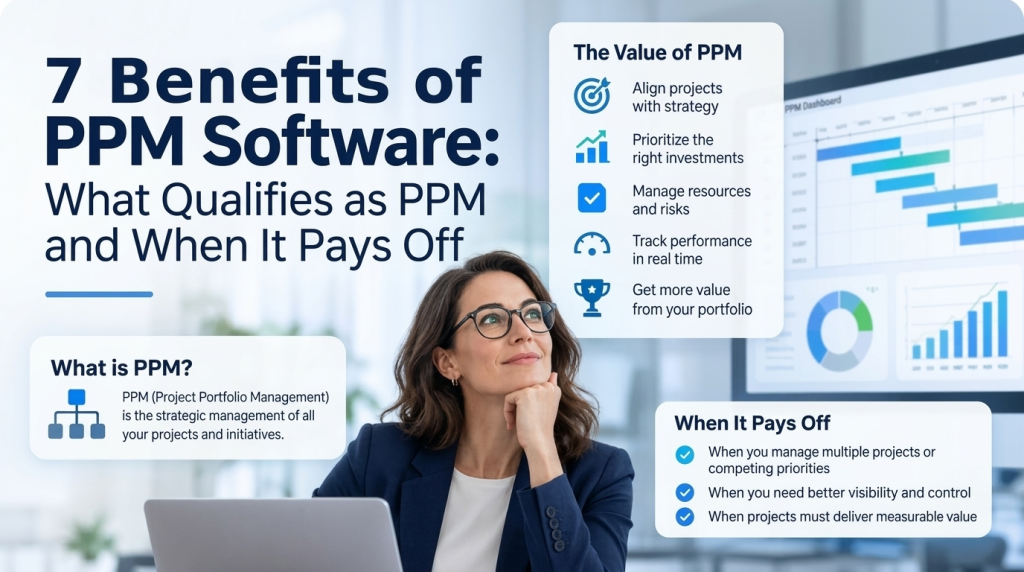
Before you can judge the benefits of project portfolio management software, you need to know what the software must actually do. This guide sets out eight tests a platform should pass, then ties the benefits to real enterprise scenarios, with the research behind them and the limits of that research.
The main benefit of PPM software is better decisions about which work to fund, staff, delay, or stop, backed by a shared view of the whole portfolio and a record of how each decision was made. Research links these platforms to better portfolio results, but one large study found the gains appear only where project, portfolio, and risk processes are already formalized.[5]
A note on bias: Completix makes PPM software, so we have an interest in this topic. This guide describes what any platform should do, not how ours works, and some links lead to our own pages on each subject. The research is listed at the end so you can check it yourself.
What is project portfolio management?
PMI's portfolio standard, as described in a PMI paper, defines portfolio management this way:[1]
“The centralized management of one or more portfolios, which includes identifying, prioritizing, authorizing, managing, and controlling projects, programs, and other related work, in order to achieve specific strategic business objectives.”
That wording matters because of its verbs. Project management asks how to deliver a given project. Project portfolio management asks which work should be approved at all, and whether that choice still makes sense as conditions change. The ISO guidance on the subject follows the same path, with clauses on selection criteria, assessing candidates, alignment, performance reporting, balancing the portfolio, and governance.[2]
What software must do to be called PPM
No single authority certifies a product as PPM, and the label gets applied generously. So we built the eight tests below by combining PMI's definition, the structure of ISO 21504, G2's published requirements for its PPM category, and the features Gartner lists for the market.[1][2][3][4] The list is our own judgment, weighted for larger organizations. The tests are written so you can apply them to any vendor.
Test 1One inventory of all workProposed and active projects and programs sit in one place, grouped into portfolios.Ask: Can I see everything we have proposed or approved, across every department, on one screen?
Test 2Intake before approvalProposed work is captured and assessed before it becomes a project, not just tracked afterward.Ask: Where does a request live before anyone says yes?
Test 3Prioritization and authorizationCandidates are compared against shared criteria and objectives, and the decision is recorded.Ask: How do I compare two competing requests, and who is recorded as approving one?
Test 4Capacity across projectsResource demand is planned across the portfolio, against the people actually available.Ask: Who is overcommitted next quarter across all projects?
Test 5Portfolio-level financialsBudgets, forecasts, and actuals roll up across projects, so spending can be compared with what was approved.Ask: What will this portfolio cost by fiscal year, and how does that compare with the plan?
Test 6Cross-project dependencies and riskLinks between projects and risks to the portfolio are visible beyond each project's own log.Ask: If this project slips, what else moves?
Test 7Balancing and what-if analysisDifferent portfolio mixes can be weighed before committing, across money, people, and time.Ask: What happens if we cut 10% or add one program, without changing live plans?
Test 8Governance and performance reportingPortfolio results are reported from shared data, and approvals and changes leave a history.Ask: Who approved this change, when, and what was reported at the time?
What does not qualify on its own
Good tools can fail these tests simply because they were built for a different job.
A task board with a roll-up dashboard. It reports on work already underway. It may not help you decide what should start.
A resource planning tool. It can pass test 4 while having no intake, financial roll-up, or decision history.
A BI dashboard over spreadsheets. It can display a portfolio, but the decisions and the record of them still happen somewhere else.
In an enterprise, add a ninth practical test: integration. Gartner makes integration a mandatory feature for its neighboring market, on the reasoning that portfolios draw on information managed in other applications.[4] Ask which connections are standard and which would be a custom project.
What changes in enterprise PPM: financials move to the center
All eight tests apply at any size, but they do not carry equal weight. A smaller organization can often treat PPM as a way to track and coordinate work. Enterprise PPM is also a way to decide how a large pool of money gets allocated, which makes test 5 the one that tends to separate platforms. This is our judgment from working with PMOs, not a research finding.
Capital and operating budgets, kept apart. They often follow different approval and accounting rules, so a single budget figure hides what leadership needs to see.
Multi-year funding by fiscal year. A program can be approved once and funded over several years, so the view has to show each year's commitment, not just a project total.
Traceable funding sources. Approved amounts should trace back to where the money comes from, often across several lines of business with their own budgets.
Forecast against approved budget. The useful signal is a growing gap while there is still time to act, rather than a variance reported after the money is spent.
A clear relationship with the ERP. The ERP usually stays the financial system of record, so decide early what the two systems exchange and how they reconcile.
A quick check: ask a vendor to show one multi-year program from request to current forecast, split by capital and operating cost and by fiscal year. If that takes several exports and a spreadsheet, finance will probably keep running the real numbers somewhere else.
What the research says about PPM software
Much of what is written about PPM benefits comes from vendors, including us. A 2005 study of IT portfolios pointed out that such claims are typically backed only by anecdote.[6] Independent evidence is thinner, but it does exist, and it is more interesting than the usual lists.
181project portfolios in a 2020 study that linked PPM system use to better portfolio results, when processes were formalized.[5]
32%of surveyed project professionals said they always or often use portfolio management software, against 66% for project management software.[9]
45%average budget overrun on large IT projects, in research on more than 5,400 projects, with 56% less value than predicted.[11]
Software helps, with a condition. Kock and colleagues studied 181 portfolios, with two informants each. PPM systems were generally linked to better management quality and portfolio success, but the effect only appeared with enough formalization in project, portfolio, and risk management. To the authors' surprise, portfolio size and complexity did not change the benefit.[5]
Adoption tracks with results. De Reyck and colleagues found a strong correlation between increasing PPM adoption and fewer project-related problems, as well as better project performance.[6]
Risk visibility matters. In a study of 176 German medium-sized and large firms, risk transparency and the capacity to cope with risk each had a direct positive effect on portfolio success.[7]
Read this with care: these studies show association, not proof that software alone caused the improvement. The McKinsey figures describe large IT projects, not PPM users. PMI's survey is useful for direction, though one recent review cautions that its advocacy framing and changing metrics make it weaker as empirical evidence.[10]
7 benefits of PPM software, tied to enterprise scenarios
The benefits do not map one to one to the tests, because most rely on a combination of capabilities. If a product cannot pass the matching test, the benefit will be hard to realize, however it is marketed. Unless a source is cited, the reasoning here is our own view from working with PMOs.
For each benefit, we describe what a proper PPM platform should do, then which parts are usually native and which are often customized. Native means built into the product and set up through configuration. Customized means the provider or a partner changes or extends the code, so the platform can do something it does not do out of the box.
Neither is automatically better. A native feature is usually quicker to adopt but follows the vendor's way of working. A customization can fit your process exactly, but it has to be specified and tested, and you should know who looks after it. An enterprise will likely need some of both. The split we show is typical, in our judgment, and varies by vendor. So for anything on your must-have list, ask:
Is it in the product today, or would it be built for us?
If built, who does the work, how long does it take, and what does it cost now and each year after?
Will it keep working after product upgrades, and who is responsible if it does not?
After go-live, can our own team change it, or do we need to go back to the vendor or a partner?
1New work gets compared before it gets started
Relies onTest 1Test 2
The scenario
Plants, IT, and compliance each send requests through a different inbox, with different levels of detail. In a manufacturing capital program, the committee may end up comparing a slide with an email thread.
What a proper PPM should do
Provide a separate request form for each type of work, so a capital request and an IT request each capture what reviewers need.
Route each request to the right approvers by rule, based on its content, such as amount, request type, or business unit.
Support staged review gates, so a request earns more detail as it advances and nobody writes a full business case on day one.
Let reviewers approve, reject, or ask for more information, and log each action with who took it and when.
Show all open requests in one filterable list, so duplicates and overlaps are easy to spot.
Turn an approved request into a project without anyone retyping the information.
Usually nativeRequest forms, approval routing, review gates, the action log, and converting a request to a project.
Often customizedLinks to procurement or finance systems, unusual multi-phase capital processes, and calculations specific to your organization.
The benefit: structured project intake gives requests a common format and a visible route to a decision, so duplicates and weak cases can be spotted before money or people are committed. It also gives the PMO a true count of demand, which is hard to produce when requests live in separate inboxes.
The limit: the organization still has to agree who decides what. If approved work can still start through a side door, the platform only captures part of the portfolio.
2Priorities get argued on shared criteria
Relies onTest 3
The scenario
Two divisions each call their largest project top priority, using different definitions. The committee ends up deciding on who presents best.
What a proper PPM should do
Let you define your own scoring criteria and weights, and change them as priorities change.
Apply the same criteria to every candidate of a given type, and show the score beside cost and timing.
Link each project to the objectives it is meant to support, so work with no clear purpose is easy to question.
Keep mandatory work separate, so regulatory or safety projects do not compete on points.
Record the decision and the reasoning, including for requests that were declined.
Usually nativeScoring fields and weights, links to objectives, list views and filters, and a record of decisions.
Often customizedScores calculated from your own financial models, data pulled from outside systems, and a ranking view built around how your committee works.
The benefit:portfolio prioritization against agreed criteria makes the trade-off explicit. People may still disagree, but they disagree about the same facts, and the reasoning can be reviewed later. Over time, the record of what was approved and declined also shows whether the portfolio reflects the priorities leadership says it has.
The limit: a score supports judgment, it does not replace it. Mandatory work, such as a regulatory deadline, usually needs its own path instead of competing on points.
3Overcommitment becomes visible before approval
Relies onTest 4
The scenario
A steering committee approves three reasonable programs in one quarter. All three depend on the same small group of engineers, and the conflict only surfaces months later.
This is a documented pattern. Engwall and Jerbrant's case studies named resource allocation as a leading challenge of multi-project management, with internal competition for people and constant reallocation that often hurt other projects.[8]
What a proper PPM should do
Hold allocations for named people and roles across every project, including contractors and agency staff.
Compare demand with available capacity by period, and make over-allocation obvious.
Let proposed work be modeled as demand, clearly marked, without taking anyone away from committed work.
Warn when allocation crosses a threshold you set, so conflicts do not wait for the next planning cycle.
Show planned effort next to actual time, where time is tracked, so future estimates can improve.
Usually nativeAllocation by person and role, capacity against demand views, modeled demand, and threshold warnings.
Often customizedSyncing people data from an HR system, detailed skills catalogs, and connections to a separate timesheet tool.
The benefit:resource and capacity planning across projects shows demand against the people available, while there is still time to sequence the work. The committee can choose to delay, add staff, or decline, knowing what each option costs before it approves.
The limit: those authors saw the problem as a symptom of how organizations commit and account for work, which makes it a matter for executives.[8] A heatmap can reveal overcommitment, but leaders still have to say no.
4Trade-offs can be tested before a decision
Relies onTest 5Test 7
The scenario
A budget gets cut mid-year, or a regulatory program moves up. Leadership wants options by Friday, and the data sits in spreadsheets that do not connect.
What a proper PPM should do
Create a scenario without changing live project data.
Hold budget, resourcing, and schedule together in one scenario, so a change in one shows its effect on the others.
Let you move funding between initiatives or push a date, and see which linked work moves with it.
Compare two or more scenarios side by side.
Make applying a scenario a deliberate step, and keep the rejected options on file as a record of what was considered.
Usually nativeCreating and comparing scenarios across money, people, and dates, then applying the chosen one.
Often customizedFinancial measures specific to your organization, links to external planning models, and automated optimization.
The benefit:scenario planning lets the PMO compare alternatives across cost, capacity, and timing without changing live plans. ISO guidance lists balancing and optimizing the portfolio among the activities of managing one.[2] In practice, leadership gets a few real options with their consequences spelled out, not one recommendation assembled overnight.
The limit: a scenario is only as reliable as the estimates inside it. Treat the output as a basis for discussion, not as a forecast.
5Portfolio risks surface earlier
Relies onTest 6
The scenario
Each project reports green. Yet two of them depend on the same delayed vendor, and nobody sees the combined exposure until a shared milestone slips.
What a proper PPM should do
Let you link dependent projects and show the downstream effect when a date moves.
Keep risk and issue logs with owners, status, and change history, and let the PMO view them across projects.
Run configurable warnings on hard numbers and dates, such as budget, schedule, and over-allocation.
Show those warnings separately from a project manager's reported status, so a green report cannot hide a real variance.
Put warnings in front of a named person to review, instead of relying on someone noticing a chart.
Usually nativeRisk and issue logs, project dependencies, configurable warnings, and portfolio-level views.
Often customizedFeeds from delivery tools or vendor systems, links to an enterprise risk register, and risk models specific to your industry.
The benefit:portfolio risk management looks across projects, not just inside them. That fits Teller and Kock's finding that risk transparency and the ability to respond both contribute to portfolio success, and that integrating risk management into portfolio management supports that ability to respond.[7] The PMO can then deal with a shared exposure while options remain, not after several projects have already slipped.
The limit: visibility is not response. Someone has to own each exposure and have the authority to act on it.
6Finance and leadership work from one set of numbers
Relies onTest 5Test 8
The scenario
The CFO asks where capital and operating spend will land for the year. The PMO chases dozens of trackers and answers a week later with numbers that are already out of date.
What a proper PPM should do
Hold approved budget, forecast, actuals, and estimate at completion for each project, and roll them up by portfolio.
Split figures by capital and operating cost, and by fiscal year.
Trace approved amounts back to their funding source.
Let finance lock figures to a date, so everyone in a review is looking at the same numbers.
Produce status reports and executive views from the same data, in a form leadership can use without a separate deck.
Usually nativeBudget, forecast, and actuals roll-ups, capital and operating splits, fiscal-year views, dashboards, and exports.
Often customizedActuals from an ERP, mapping to your chart of accounts, company-specific currency rules, and board reports in a fixed format.
The benefit:portfolio reporting built on shared data moves analysts from assembling reports to reviewing them. It also makes a growing gap between approved budget and forecast easier to see while choices remain. With overruns on the scale McKinsey reported for large IT projects, that time matters.[11] Reviews can then focus on what to do about the numbers, not on whose numbers are right.
The limit: the ERP typically remains the financial system of record, so finance still reconciles against it. Any connection between the two needs a data mapping, because ERPs often do not organize costs the way a project portfolio does.
7Decisions can be traced when someone asks
Relies onTest 3Test 8
The scenario
An auditor asks who approved a budget increase on a multi-year program, and whether it followed policy. In a government portfolio or a regulated business, searching through email is not a good answer.
What a proper PPM should do
Log every request, approval, and change with who acted and when.
Apply approval policies by rule, and show which policy or version applied to a decision.
Control changes to the baseline, so approved dates and budgets change only through an approved request or a user with permission.
Keep posted status reports as fixed snapshots, so you can see what was reported at the time.
Control access by role, and make records easy to pull together for an auditor.
Usually nativeActivity history, approval policies, change requests, report snapshots, and role-based access.
Often customizedSingle sign-on setup where it is not standard, archiving to a records system, and reports for a specific regulator.
The benefit:portfolio governance records become a by-product of doing the work, which reduces the effort of rebuilding a history later. When a decision is questioned, the answer is a lookup, not a search through old email. ISO 21504 treats governance and visibility as prerequisites for portfolio management, so this is more than an audit convenience.[2]
The limit: a system records the approvals your policy produces. Whether the policy is any good, including who is allowed to approve what, remains your responsibility.
Choosing a PPM platform: day 10 is not day 360
No PPM platform is ready to go for an enterprise on day one. It has to be shaped around your approvals, funding rules, reporting, and structure. And that shape keeps changing, because processes mature, organizations reorganize, and leaders ask new questions.
Day 10Live, built on your best understanding of your processes
Day 120Real use exposes gaps in forms, approvals, and reports
Day 360New rules, structures, and needs call for what it did not ship with
So when you compare platforms, the ability to customize the product matters as much as the product itself, and often more.
Timeline is illustrative.
A feature comparison shows you a platform as it looks on the day of the demo. It says little about whether that platform will still fit a year later. ISO 21504 lists improving portfolio management among its prerequisites,[2] and in our experience, that is the point where a platform either keeps up or gets worked around with spreadsheets.
By customization, we do not mean adding a field during a demo. That is configuration, and it is the minimum to expect. We mean the provider's ability to change the code when you need something the product does not do out of the box. A customer may need a new type of complex custom field, for example, or an ERP integration with behavior specific to how its finance team works. So ask for evidence, not promises:
Bring a hard requirement. Give the vendor something the platform does not do today. Ask how it would be built, who would do the work, how long it would take, and where you would review it before release.
Ask what has been built before. Ask a reference customer which code-level changes the provider made for them, including after go-live, and how long each one took.
Get the terms for custom work. Find out whether it is included or priced per request, and whether that still holds in year three.
Find the limits. Ask what the provider will not change, and what happens when a request affects the core product.
Keep the focus on the benefit: customization is not the goal in itself. Each change should have a clear purpose, such as a better decision, less manual work, or a stronger record. If you cannot name the benefit, the standard approach is probably good enough.
PPM software claims to treat with caution
You will see the following on many benefit lists, including vendor sites. They deserve a harder look before they go in a business case.
“Guaranteed higher success rates.” The research shows associations, conditional on process maturity. Ask for the method and comparison group behind any percentage.[5][6]
“Automated decisions.” Software can route requests and flag variances. Stopping a sponsor's project remains a human decision, and in a regulated business, it should be.
“Real time means accurate.” A live view of a stale forecast is still a stale forecast.
“Better collaboration.” It may be real, but it is not a reason to buy PPM. If messaging and task boards are the main goal, a work management tool may be the better fit.
How to measure the benefits of PPM software
Generic ROI figures will not persuade a CFO, but your own before and after numbers might. Record a baseline over one or two planning or reporting cycles, then repeat the same measures after a full cycle in the new platform. These are suggested measures, not industry benchmarks.
Measure
What to record
Decision time
Days from a complete request to a recorded decision, by request type
Decision record
Share of active projects with a traceable approval and funding decision
Reporting effort
Hours spent producing each monthly or quarterly portfolio pack
Forecast reliability
Gap between mid-year forecast and final cost, across completed projects
Capacity conflicts
People above 100% in the coming quarter, and how early each conflict was found
Late surprises
Significant variances first discovered in a steering meeting, rather than before it
Then look for the portfolio decision itself. Strong evidence of value is often a project that was stopped, resequenced, or never started because the trade-off was finally seen in time.
When PPM software will not help yet
Kock's findings point to the most useful question a PMO can ask before buying: are our processes defined well enough for a system to support them?[5] It may be too early if:
You run a handful of projects from one budget, and people do not compete for the same resources.
Nobody has the authority to stop or delay work, so better information would not change any decisions.
You have no agreed project, portfolio, or risk process yet. Define a simple one first, and let the software support it.
If those do not describe you, use the eight tests to build a shortlist. Our PPM software comparison is one starting point, and if governance is the main concern for your PMO, our guide to the best PMO tools for portfolio governance narrows the field further. It is reasonable to read both knowing they come from a vendor. Independent reviews and a demo focused on your hardest scenario will tell you more than any vendor's list, ours included.
PPM software benefits, common questions
What are the main benefits of project portfolio management software?
The main benefits are better decisions about which work to fund and staff, earlier sight of capacity conflicts and risks, one shared set of portfolio numbers, and a clear record of who decided what. Research links PPM systems to better portfolio results, mainly where processes are already formalized.
What features must software have to be considered PPM software?
There is no formal certification. At a minimum, it should hold one inventory of proposed and active work, support intake and prioritization, plan capacity and financials across projects, show cross-project dependencies and risks, allow what-if comparisons, and report on the portfolio with a history of decisions.
How is PPM software different from project management software?
Project management software helps a team deliver a given project. PPM software helps an organization decide which projects to run, how to fund and staff them, and whether they still make sense. Some products do both, so check each capability rather than relying on the label.
What is enterprise PPM?
Enterprise PPM applies portfolio management across a large organization, usually with several lines of business, multi-year funding, separate capital and operating budgets, and an ERP as the financial system of record. Compared with smaller deployments, financial control and governance tend to matter much more.
Is there evidence that PPM software improves results?
Yes, with limits. A 2020 study of 181 portfolios linked PPM system use to better portfolio success, but only with enough process formalization. A 2005 study found a strong correlation between PPM adoption and project performance. These findings show association, not proof that software alone caused the gains.
How do you calculate the ROI of PPM software?
Measure your own baseline first, then compare it after a full cycle in the new platform. Useful measures include decision time, reporting hours, the gap between forecast and final cost, and how early capacity conflicts are found. Add the value of work you stopped or resequenced because of what you saw.
What is the difference between PPM and strategic portfolio management?
The terms overlap and vendors use them differently. Gartner defines its strategic portfolio management market around enterprise-wide planning toward desired business outcomes, while PPM is the longer-established label for selecting and managing projects and programs. Compare actual capabilities, not category names.
When does an organization need PPM software?
The usual signs are several teams competing for the same people and budget, approvals that happen by email, and leadership questions that take days to answer. A small team with a few projects and one budget often does not need it yet.
Sources
Ross, D., and Shaltry, P. (2006). The new PMI standard for portfolio management. Project Management Institute. Definition as described in this paper; later editions of the standard revise the wording.
International Organization for Standardization. ISO 21504:2022, Project, programme and portfolio management, Guidance on portfolio management. Scope, ISO TC 258, and contents preview. We relied on the published scope and clause headings, not the full text.
Project Management Institute (2024). Pulse of the Profession 2024: The Future of Project Work. Survey of 2,246 project professionals and 342 project leaders, June to August 2023. A further 19% said they sometimes use portfolio management software.
Take the eight tests to every vendor on your list, including us. If you would like to run them against Completix, we are happy to walk through them with you.